CRM vs All-in-One Marketing Platform for Small Businesses
Small businesses often face a key software decision: whether to adopt a dedicated Customer Relationship Management (CRM) system or to choose an all-in-one marketing platform that integrates CRM with marketing automation, email campaigns, and funnel management. Both approaches aim to streamline customer management and marketing efforts, but their focus, features, and suitability can differ significantly. This guide evaluates the core differences and capabilities of CRM software versus all-in-one marketing platforms, based on verified feature data from providers like GoHighLevel and Systeme.io. Understanding these distinctions helps small business owners and decision-makers select software tailored to their specific needs, budget, and growth plans.
6 min read · Published 12 October 2026
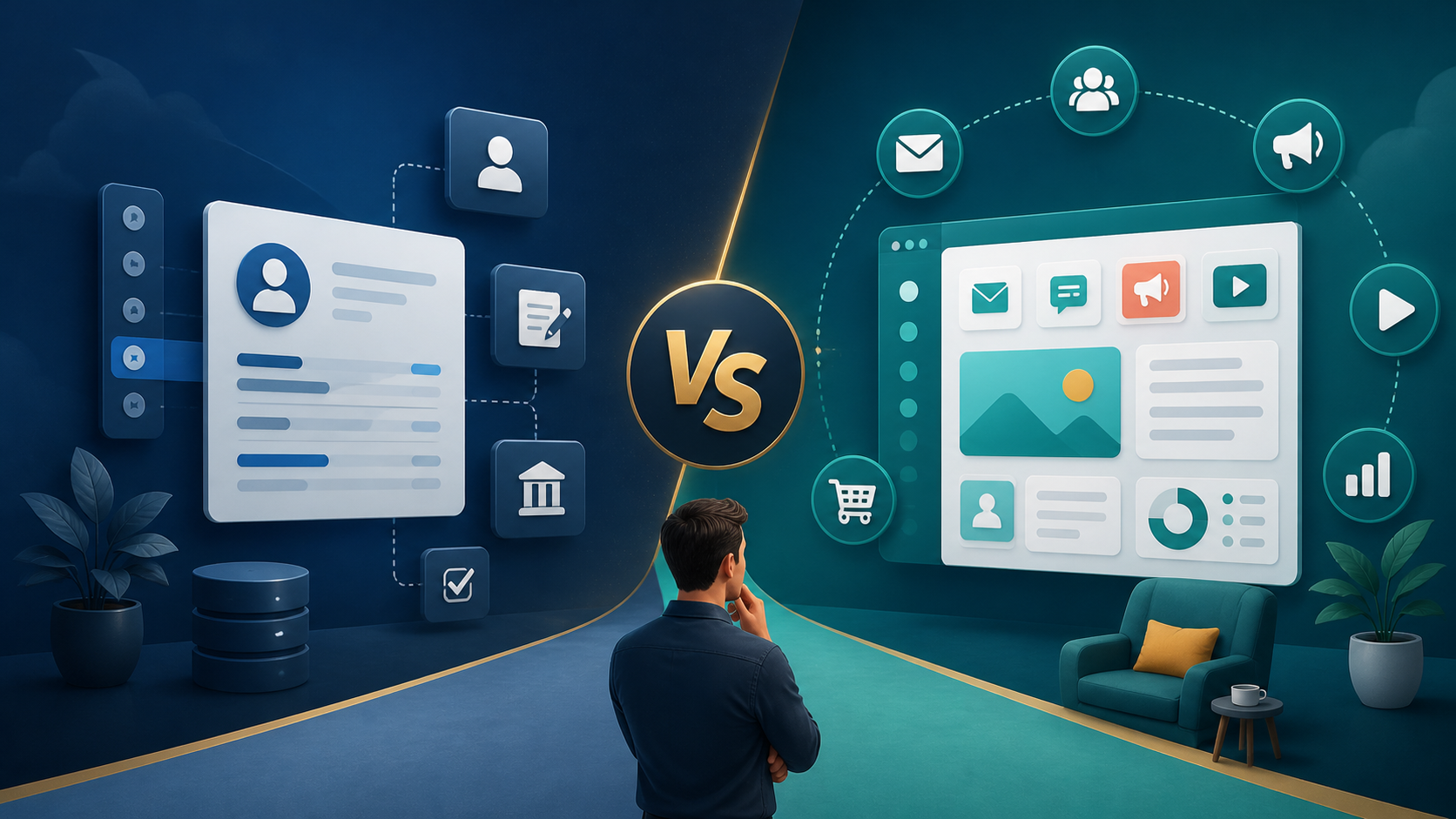
Understanding CRM Software: Core Features and Focus
CRM software is designed primarily to manage contacts and sales processes. The core functionality typically includes managing contacts, tracking interactions, and organizing sales pipelines. For example, GoHighLevel’s CRM functionality revolves around contacts and sales pipelines, emphasizing streamlined customer relationship tracking to support sales efforts. Similarly, Systeme.io offers CRM features such as managing contacts, tags, and CRM pipelines, which helps segment customers and visualize their journey in the sales process. Small businesses that focus on managing their sales funnel and maintaining structured contact information often benefit from dedicated CRM software.
Key questions to consider include: Do you need specialized tools just for sales tracking and pipeline management? Would your team benefit more from managing contacts and leads in a focused environment without additional marketing tools? Answering these can guide the initial choice of dedicated CRM versus broader platforms.
All-in-One Marketing Platforms: Integrating Multiple Tools
All-in-one marketing platforms combine CRM features with marketing tools such as email marketing, automation workflows, funnel and website builders, and appointment scheduling. For instance, GoHighLevel provides email marketing, funnels, automation, and booking capabilities alongside its CRM modules. Similarly, Systeme.io integrates email campaigns, sales funnels, online courses, and marketing automation rules with its CRM functions.
Such platforms aim to reduce the need for multiple separate tools by unifying customer relationship management with marketing engagement and sales processes in one interface. This consolidation can simplify workflows, provide a more comprehensive overview of marketing and sales activities, and reduce integration challenges.
When considering all-in-one platforms, small businesses should ask: Do you require a single solution that handles your marketing campaigns, lead nurturing, website or funnel creation, and scheduling alongside CRM? Would having these tools integrated by default improve your team’s efficiency? These factors influence whether an all-in-one platform is advantageous.
Feature Comparison: CRM versus All-in-One Platforms
Feature sets highlight differences between the software types. CRM-focused tools concentrate on contact management and sales pipelines. All-in-one platforms incorporate those CRM capabilities plus marketing extensions—like marketing email campaigns, funnel building, automation triggers, and appointment booking.
For example, GoHighLevel’s features include:
- CRM: Contacts and sales pipelines
- Email marketing
- Appointment scheduling
- Funnel and website builders
- Workflow automation.
Systeme.io’s comparable features include:
- CRM: Contacts, tags, CRM pipelines
- Email campaigns and newsletters
- Online courses
- Sales funnels and upsells
- Automation rules and workflows.
This juxtaposition illustrates that while CRMs focus narrowly on customer and sales management, all-in-one platforms extend functionality broadly across marketing and sales, offering more marketing-centric features out-of-the-box.
When to Choose a CRM: Use Cases and Considerations
Opt for a dedicated CRM system if your primary requirement is organized sales pipeline management and detailed contact tracking without the immediate need for integrated marketing features. Small businesses with established marketing tools might prefer a CRM to complement existing software without complicating workflows.
Questions to evaluate include: Are your marketing campaigns handled externally or through other software? Do you require advanced sales tracking, reporting, or segmentation specifically focused on contacts and lead stages? Also consider compatibility with existing tools and whether adding marketing modules would create redundancy or complexity.
CRMs may also have steeper learning curves if used for broader marketing needs they are not designed to address.
When an All-in-One Marketing Platform May Be the Better Fit
An all-in-one marketing platform suits small businesses needing a unified software solution that covers lead management, marketing campaigns, sales funnel creation, and customer engagement automation.
Choosing platforms like GoHighLevel or Systeme.io can reduce the need to integrate multiple specialized tools, lowering operational complexity and potentially reducing costs related to managing separate subscriptions.
Consider these questions: Does your business need easy-to-use email marketing combined with CRM? Are you creating sales funnels or online courses in addition to managing customers? Do you want automation rules linking marketing and sales actions? If yes, an integrated all-in-one solution might better meet your streamlined process goals.
Pricing and Limitations: What the Evidence Shows
Verified pricing details for GoHighLevel and Systeme.io are available but not reproduced here; interested readers should consult the providers directly for current prices and plans. The evidence confirms the presence of numeric pricing plans but does not support unsupported pricing claims or promises.
Both software types have limitations influenced by their scope. Dedicated CRMs may lack native email marketing or funnel-building tools, requiring additional software purchases. All-in-one platforms might offer broad feature sets but can be more complex to configure or may not provide as deep CRM-specific functionalities found in standalone systems.
Small businesses should weigh trade-offs between feature depth and breadth versus usability and integration demands when assessing costs and limitations.
Evaluating Your Business Needs: Practical Advice
To decide between CRM and an all-in-one platform, start by listing your business goals, workflows, and existing software landscape. Evaluate how critical sales pipeline management is versus comprehensive marketing automation and funnel needs.
Ask: How much time can your team allocate to learning and managing software? Do your marketing and sales teams operate together or separately? Are you aiming for rapid deployment or building a custom software stack? Consider also data centralization preferences and future scalability.
When possible, explore free trials or demos (not included in this evidence) to understand usability. Reviewing verified feature lists as presented here provides a factual baseline before deeper evaluation.
Making this assessment helps avoid the common pitfall of either investing in fragmented tools or adopting overly complex platforms mismatched to your operational maturity.
Summary and Next Steps
Small businesses deciding between CRM and all-in-one marketing platforms should base their choice on clearly understood feature requirements and workflow needs. CRMs focus on customer and sales management, while all-in-one marketing platforms extend this functionality into integrated marketing features like email campaigns, funnels, and automation.
Consult verified feature data from providers such as GoHighLevel and Systeme.io to compare what each offers exactly, and align this with your operational priorities.
Next steps include exploring dedicated guides on selecting software, reviewing internal links to deepen knowledge about CRM and marketing automation, and carefully evaluating pricing and plans through official vendor channels to understand cost implications.
Your choice influences ease of scaling marketing efforts, managing customer relationships, and overall business efficiency.
Frequently asked questions
What is the main difference between a CRM and an all-in-one marketing platform?
A CRM mainly focuses on managing contacts and sales pipelines, while an all-in-one marketing platform combines CRM features with marketing tools like email marketing, funnels, and automation workflows.
When should a small business choose a dedicated CRM?
Choosing a dedicated CRM is suitable when the focus is on detailed sales pipeline and contact management without needing integrated marketing tools, or when specialized sales tracking is a priority.
What benefits do all-in-one marketing platforms provide?
All-in-one platforms offer integrated solutions that handle not only CRM but also email campaigns, funnels, automation, and scheduling, potentially simplifying workflows and reducing the need for multiple tools.
Is pricing for GoHighLevel or Systeme.io included in this guide?
This guide confirms that verified numeric pricing exists for both providers but does not include specific price details; readers should consult the providers' official sites for current pricing.
Affiliate disclosure: Some outbound links on this page are affiliate links. If you sign up through one we may earn a commission at no extra cost to you. Affiliate relationships never determine our editorial rankings. See our Affiliate Disclosure for the full methodology.
Want It Set Up and Managed for You?
Choosing software is only the first step. Our business-systems partner, Legacy Digital, builds, connects, automates and manages your website, CRM and marketing systems — done for you.
Disclosure: Legacy Digital is our commercial partner. This referral is separate from our editorial reviews and never affects software rankings.
Explore Managed Business Solutions- ✓Website design and development
- ✓CRM implementation
- ✓AI automations
- ✓Lead follow-up systems
- ✓SEO and marketing
- ✓Business systems management